An AI readiness assessment determines whether a specific business use case has the outcome clarity, workflow discipline, usable data, system access, ownership, controls, and measurement needed to move into a controlled pilot.
The important word is specific. A company is not simply ready or unready for AI. It may be ready to test an internal policy assistant while being completely unprepared to let an AI agent update customer records or approve a financial transaction.
For UAE leadership teams, the assessment should answer three commercial questions before more budget is committed:
- Is this problem valuable enough to solve?
- Can we test it safely with the information and systems we have?
- What must change before the solution can operate in production?
This guide provides a practical scorecard your business, operations, IT, data, security, and legal stakeholders can use together. It is a planning tool, not a compliance certification or legal opinion.
What should an AI readiness assessment produce?
A useful assessment should end with a decision, not a generic maturity label. Leadership should receive a prioritised use case, evidence of the main gaps, a recommended architecture direction, required controls, a staged delivery plan, and a realistic basis for estimating cost and timing.
The outcome may be to proceed with a limited pilot. It may also be to improve the data, simplify the process, strengthen access controls, or use conventional automation instead. Identifying that work early is a successful assessment result because it prevents a weak pilot from becoming an expensive production problem.
Start with one use case, not a company-wide AI ambition
Statements such as "we want to use AI in customer service" are too broad to assess. A workable use case describes the input, the task, the output, the user, the system involved, and the person responsible for the decision.
For example:
- Too broad: Use AI to improve customer service.
- Assessable: Classify incoming service requests, draft a response from approved knowledge, and route uncertain cases to a service coordinator for review.
The second statement can be tested. The team can inspect representative enquiries, define approved knowledge, measure classification quality, confirm who reviews the draft, and identify how the result reaches the service platform.
Score the use case below from 0 to 2 in each dimension:
- 0, missing: The answer is unknown or based on assumption.
- 1, partial: Some evidence exists, but important gaps or disagreements remain.
- 2, evidenced: The requirement is documented, owned, and supported by representative evidence.
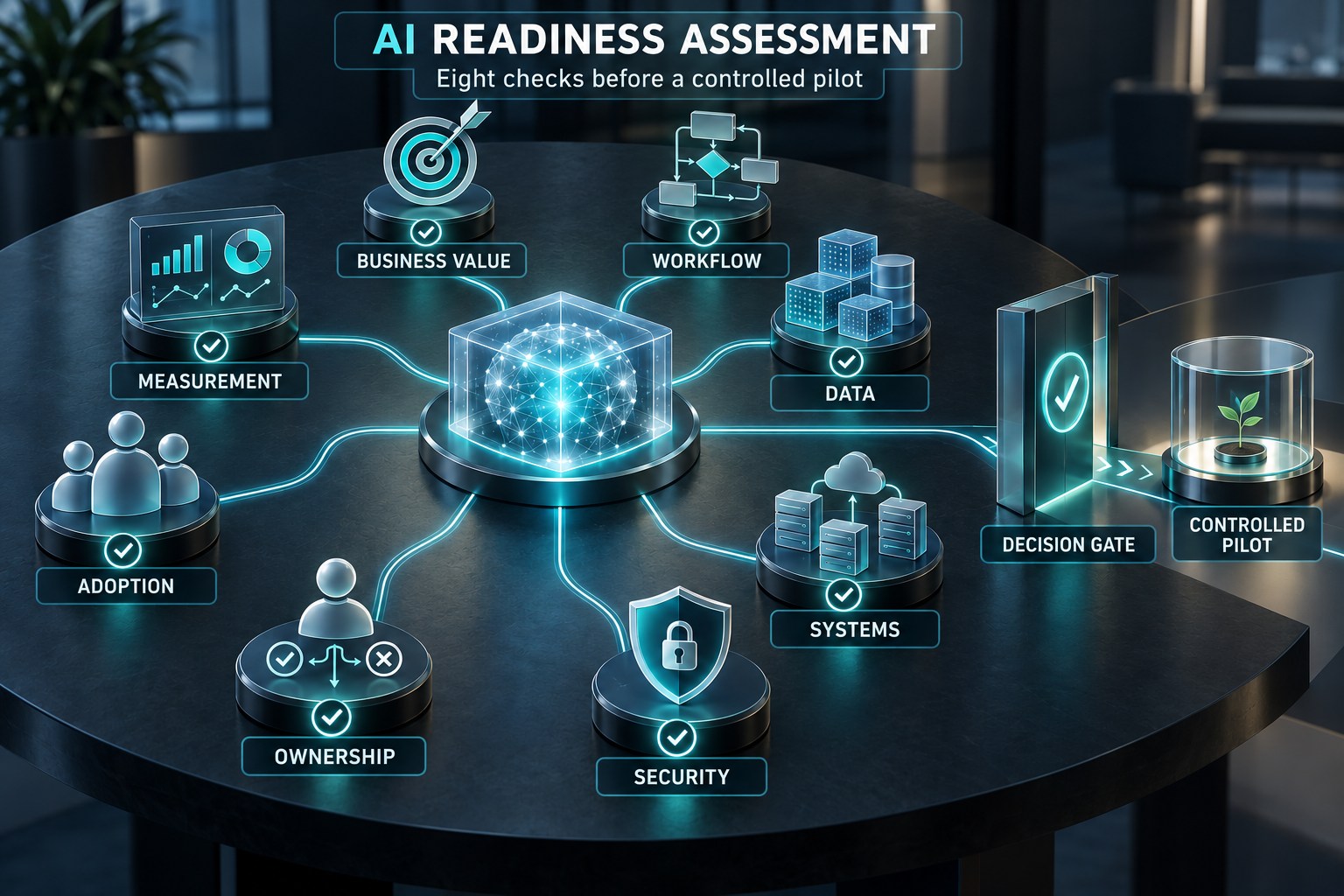
The eight-part AI readiness scorecard
1. Business outcome and value
AI is not the outcome. Define the operational change the business wants and how leadership will know whether it happened.
Ask:
- Which customer, employee, supplier, or management problem are we solving?
- What happens today, and where is time, quality, revenue, or visibility lost?
- What volume of work is involved?
- Which result matters: faster handling, fewer errors, increased capacity, better response quality, improved conversion, or another defined outcome?
- Is the opportunity valuable after review effort and operating costs are included?
Score 2 when the outcome, baseline, owner, and decision measure are defined. Score 1 when the problem is understood but not measured. Score 0 when the project starts with a tool rather than a business need.
2. Workflow clarity
AI operates inside a process. If nobody can explain the process, adding a model usually adds another unclear step.
Map who starts the work, which information they use, the systems they touch, where decisions happen, how exceptions are handled, and who is responsible at the end. Include the unofficial spreadsheet, email, or WhatsApp step if that is how work actually moves.
Score 2 when the current workflow, decision points, exceptions, and proposed AI role are documented. Score 1 when the normal path is known but exceptions are not. Score 0 when departments describe materially different versions of the process.
3. Data readiness
The question is not whether the company has a large amount of data. The question is whether the selected use case has representative, permitted, understandable, and accessible information.
Check:
- Who owns the required records and can authorise their use?
- Are the relevant fields complete and consistently defined?
- Do examples cover normal work, difficult cases, and failures?
- Is the source current, or are employees relying on outdated copies?
- Can evaluation examples be kept separate from development examples?
- Which personal, confidential, financial, health, identity, or customer information is involved?
- How long should inputs, outputs, and logs be retained?
Score 2 when authorised representative samples and ownership are available. Score 1 when the data exists but requires cleaning, permission work, or integration. Score 0 when the project depends on information the team cannot locate, explain, or lawfully use.
For a deeper review, see what business data AI should be allowed to access.
4. Systems and integration readiness
A demonstration can work with uploaded files while the real business process depends on CRM, ERP, DMS, document stores, email, identity services, or reporting systems. Production readiness depends on supported and maintainable connections.
Confirm:
- Where the source information resides.
- Whether supported APIs, database access, or controlled exports are available.
- Whether the AI system needs read access, write access, or both.
- How users will authenticate.
- What happens when a source system is unavailable.
- How changes, failures, and retries will be monitored.
- Whether development, testing, and production environments can be separated.
Score 2 when the required systems, owners, access paths, and constraints are confirmed. Score 1 when the integrations appear feasible but have not been validated. Score 0 when the proposed solution assumes access that has not been discussed with the system owner.
5. Security, privacy, and UAE requirements
Security and privacy need to be designed into the first test. They should not be added after real company data has already been copied into an uncontrolled tool.
The UAE Personal Data Protection Law establishes requirements for processing personal data and protecting confidentiality and privacy. Depending on the organisation, sector rules, contractual commitments, free-zone requirements, or client policies may also apply. Obtain appropriate legal and security advice for the specific use case.
Ask:
- What data may the system read, and what must remain excluded?
- Is information sent to an external provider, and where is it processed or stored?
- Is customer data used to train a provider's model?
- Can access follow the permissions already used by the business?
- Are prompts, retrieved records, model outputs, tool calls, and administrator actions logged appropriately?
- Can sensitive information be minimised, redacted, masked, or replaced with test data?
- How will an incident, incorrect disclosure, or unsafe action be detected and handled?
Score 2 when data boundaries, access, retention, vendors, reviewers, and incident ownership are documented. Score 1 when risks are known but controls are incomplete. Score 0 when staff are already sharing sensitive information through tools that have not been approved.
The Digital Dubai AI Ethics Principles and Guidelines provide additional principles for responsible AI design and deployment.
6. Ownership and human oversight
Every AI-assisted workflow needs accountable people. Name the business owner, data owner, technical owner, security or privacy reviewer, and operational reviewer.
Define:
- Which outputs are suggestions and which can trigger actions.
- Who reviews uncertain, high-impact, or unusual cases.
- Which actions always require human approval.
- How users challenge or correct an output.
- Who can disable the system.
- Who approves future changes to models, prompts, knowledge, or integrations.
Score 2 when decision rights and escalation routes are explicit. Score 1 when an executive sponsor exists but operational ownership is unclear. Score 0 when responsibility effectively sits with the software or its supplier.
7. People and adoption readiness
A technically correct tool can fail when it adds effort, conflicts with incentives, or arrives without practical training. Involve the people who perform and review the work before the workflow is designed.
Ask:
- Have representative users helped define the problem?
- Do they understand what the system will and will not do?
- Will the proposed interface fit the way work is performed?
- Is Arabic, English, or bilingual operation required?
- Who needs role-specific training?
- How will feedback, corrections, and recurring exceptions reach the product owner?
Score 2 when users, training, feedback, and process changes are planned. Score 1 when users have been consulted but adoption work is not assigned. Score 0 when the project assumes that access to a new tool automatically changes behaviour.
8. Measurement, economics, and operational support
A pilot must create evidence for an investment decision. Define the test conditions and acceptance criteria before development begins.
Measure more than speed. Depending on the use case, include quality, incorrect answers, review time, exception rate, successful handoff, system reliability, user adoption, and total operating cost.
Budget for:
- Implementation and integration.
- Model, platform, hosting, storage, and monitoring usage.
- Security review and testing.
- User training and rollout.
- Human review and exception handling.
- Ongoing support, maintenance, and change control.
Score 2 when baseline, acceptance criteria, operating cost assumptions, and post-launch ownership are defined. Score 1 when benefits are expected but measurement is incomplete. Score 0 when success means only that a demonstration can produce an impressive response.
How to interpret your score
Add the eight dimension scores for a maximum of 16. The result is a planning indicator, not an industry certification.
- 0 to 5, foundations first: Define the workflow, ownership, permitted data, and intended outcome before selecting technology.
- 6 to 10, validate the gaps: A focused assessment can test the uncertain data, integration, security, or adoption assumptions.
- 11 to 13, ready for a controlled pilot: The use case is sufficiently defined to design a limited test with clear controls and acceptance criteria.
- 14 to 16, assess the production path: The foundations are strong, but architecture, security, evaluation, deployment, and support still need formal validation.
A high total does not cancel a critical zero. Missing permission to use personal data, no accountable owner, or no safe review path can stop the project regardless of strengths elsewhere.
What should you prepare for the assessment?
You do not need to send an entire database before the first discussion. Begin with authorised and preferably redacted material:
- A one-page description of the workflow and desired outcome.
- The people who perform, approve, and own the work.
- Approximate volume, current handling time, recurring errors, and exceptions.
- Representative inputs and examples of correct outputs.
- A list of source systems and their owners.
- Existing security, privacy, retention, and vendor policies.
- Required languages, channels, roles, and approval points.
- Known budget, timing, and procurement constraints.
- Any existing prototype, including its code, data storage, integrations, and deployment assumptions.
If a working prototype already exists, use our prototype-to-production guide to identify what must be reviewed beyond the visible interface.
What should leadership receive at the end?
A commercially useful assessment should provide enough detail to approve, defer, reshape, or reject the next investment. At minimum, expect:
- Prioritised use cases and intended business outcomes.
- A current workflow, user, and ownership map.
- Data and integration readiness findings.
- Security, privacy, and governance requirements.
- Initial solution architecture and build recommendation.
- Pilot acceptance criteria and measurement plan.
- A phased roadmap, planning range, and next-step estimate.
TechnoSignage packages this work as an AI Opportunity and Production Readiness Assessment. The focused engagement typically takes one to two weeks once the required stakeholders and information are available. The scope, deliverables, acceptance criteria, and payment terms are agreed before work begins.
Three example readiness decisions
Internal policy assistant
The business has current approved documents, named owners, permission-aware access, and staff who can review answers. This may be ready for a controlled pilot. If policies conflict or nobody owns updates, document governance comes first.
Customer-service response automation
The team has representative enquiries and clear escalation rules, but live customer records sit behind an unconfirmed CRM integration. Test classification and drafting with approved examples while the integration and access design are validated separately.
AI agent that changes financial or customer records
The value may be clear, but write access, approval boundaries, audit history, rollback, monitoring, and exception ownership are not optional. Begin with recommendations or draft actions, then expand authority only after the controls and evidence justify it.
Frequently asked questions
How long does an AI readiness assessment take?
A focused assessment of one defined use case can often be completed in one to two weeks when the right stakeholders and system information are available. A wider programme covering several departments, regulated data, or multiple legacy systems may require more time.
Does an AI readiness assessment require clean data?
No. The assessment should identify data gaps and determine whether they can be corrected within the proposed project. It does require enough representative information to understand the task, variation, ownership, permissions, and consequences of error.
Is an AI readiness assessment the same as a pilot?
No. The assessment determines what should be tested, what controls are required, and what evidence should support the next decision. A pilot then tests the difficult assumptions with a limited workflow, users, and data.
Can a business be ready without an AI strategy?
A company-wide AI strategy is not always necessary before testing one valuable use case. The business still needs a clear outcome, accountable owners, permitted data, appropriate controls, and a decision framework for what happens after the test.
Should we buy an AI platform before the assessment?
Usually, the use case and requirements should be understood first. Otherwise, the assessment can become an exercise in justifying a purchase rather than choosing the right approach. Existing enterprise standards and licences should still be included in the review.
What if the assessment shows that AI is not the right solution?
That is a useful result. The recommendation may be conventional automation, BI, process redesign, data preparation, or no project. The purpose is to improve the investment decision, not to force AI into every workflow.
Decide what deserves a pilot
Bring one process, the people involved, the systems it touches, and the outcome you want to improve. TechnoSignage can assess the opportunity, expose the readiness gaps, define the controls, and recommend a practical route from idea to pilot or production.
Explore AI consulting in Dubai or discuss an AI readiness assessment.